

Alibaba’s Qwen3.8-Max: a 2.4T-parameter AI model breaks new ground
Alibaba’s Qwen team has just pushed the envelope once again: Qwen3.8-Max, a 2.4-trillion-parameter mixture-of-experts model, is now broadly available, with open weights scheduled for next week. The model accepts text, images, and video as input and returns text, positioning it as a versatile tool for industries from software engineering to e-commerce.
One API fits many workloads
Qwen3.8-Max is already deployable today through Alibaba’s hosted API, which supports OpenAI- and DashScope-compatible endpoints. That means switching from another provider is as simple as changing a base URL and model ID. For teams needing on-premise deployment, Alibaba is also preparing Qwen3.8-27B, a smaller checkpoint designed to run on standard GPU hardware.
Cost, context, and capability in focus
Pricing starts at $2 per 1M input tokens and $6 per 1M output tokens, with an implicit cache option at $0.25 per 1M tokens—eight times cheaper than fresh input. The model boasts a 1M-token context window, accepting up to 991K tokens in standard mode and 983K when reasoning is enabled. Maximum output is capped at 131K tokens, and the reasoning budget can reach 262K tokens. Rate limits top out at 2M tokens per minute or 15K requests per minute, giving teams plenty of headroom for heavy usage.
On the feature side, Qwen3.8-Max supports function calling, structured outputs, batches, prefix completion, and fine-tuning. The Responses API bundles five built-in tools: code_interpreter, web_search, web_extractor, t2i_search, and i2i_search.
Benchmarks: strong multimodal gains, but gaps remain
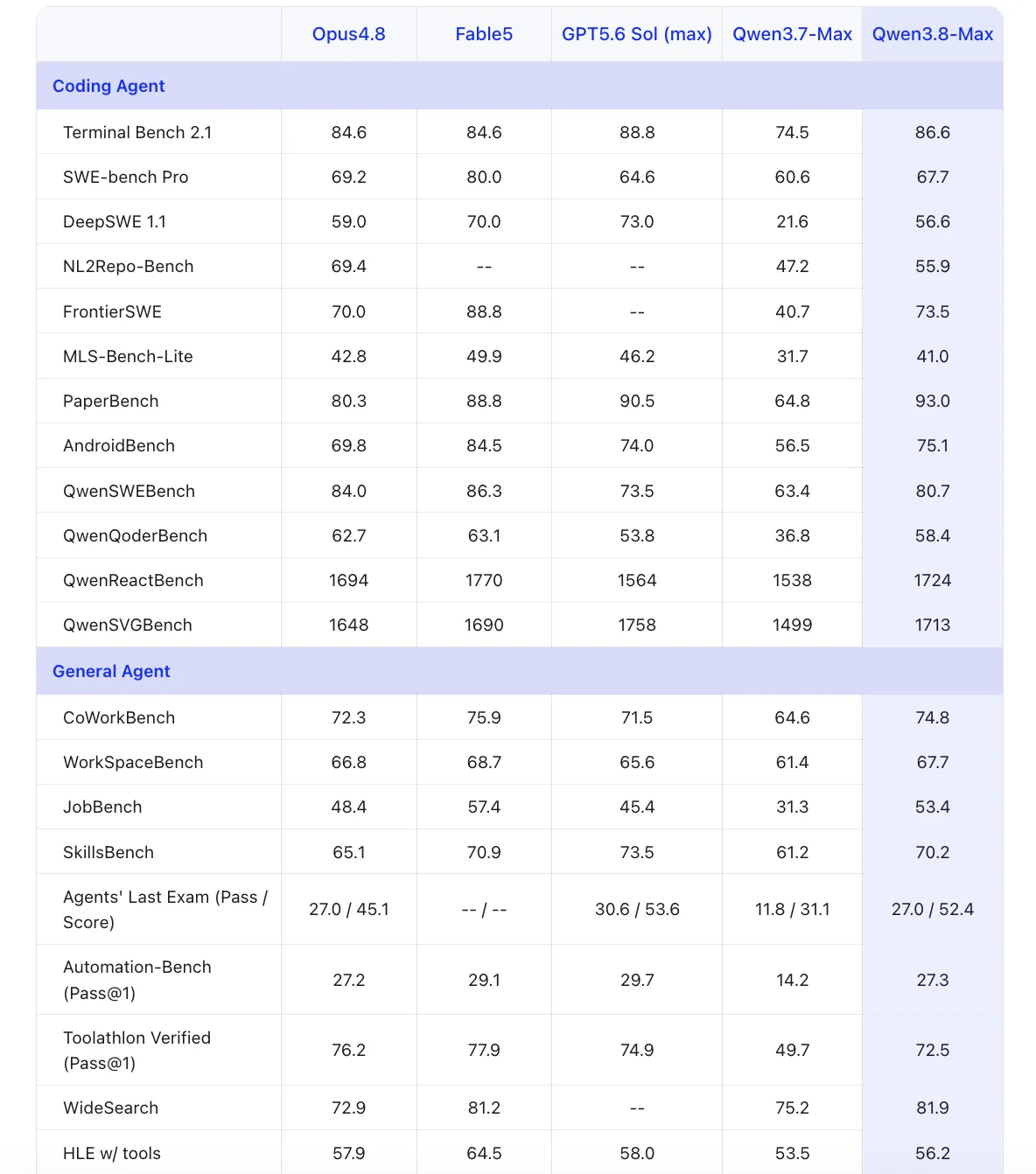
Alibaba’s published benchmarks show Qwen3.8-Max leading in several multimodal and agentic tasks, including OSWorld-Verified (86.1), Parametric CAD Bench (91.5), and OmniDocBench 1.5 (92.1). On Terminal-Bench 2.1 it scores 86.6, outperforming Claude Opus 4.8 (84.6) but trailing GPT-5.6 Sol (88.8). Software-engineering benchmarks tell a more mixed story: Qwen3.8-Max lags on SWE-bench Pro (67.7 vs Fable 5’s 80.0) and FrontierSWE (73.5 vs 88.8), though it shows marked improvement over its own predecessor across multiple agentic tasks.
Why it matters
Qwen3.8-Max’s 2.4T-parameter scale and 1M-token context open new possibilities for long-form reasoning and multimodal workflows, especially in sectors like software, legal, and design. The availability of both a hosted API and a smaller open-weight variant next week lowers barriers to adoption, while the aggressive pricing and caching discounts make large-scale usage more predictable. For teams evaluating frontier models, the trade-offs between raw capability, cost, and ease of integration have just become more interesting.
Source: MarkTechPost. AI-assisted editorial synthesis — TechnoExpress.